Costs are there.
Insight is not
We analyse the consumption profile: how it changes during the day and which processes drive the load.
 VMERY
VMERY is a hardware and software platform that reduces peak power and electricity bills. We help you see load peaks, find room for optimisation and make better use of available capacity.
Assess my site ↗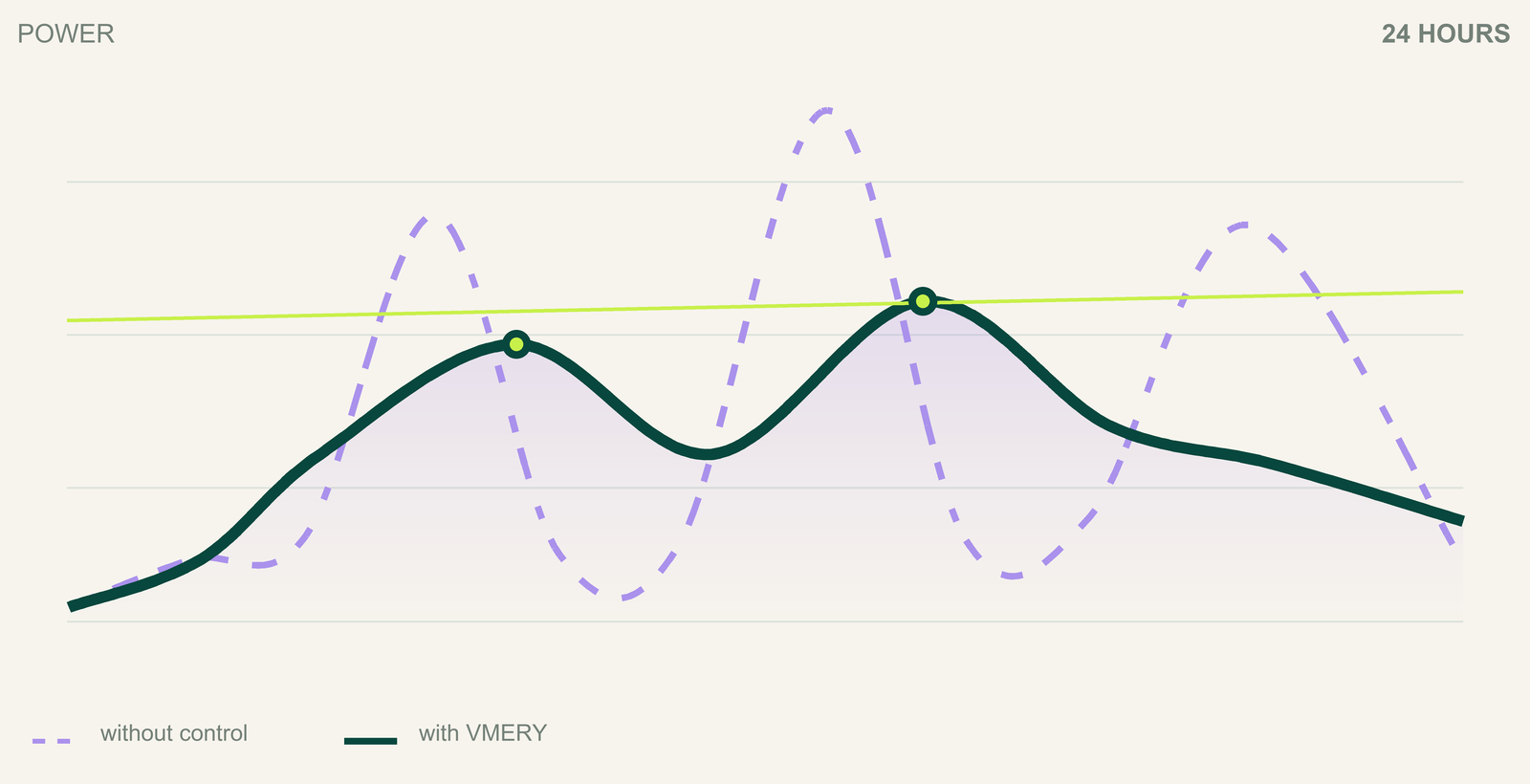
It matters not only how much energy you use, but when — and on what. We link meter readings with equipment operation and the economics of a specific site.
We analyse the consumption profile: how it changes during the day and which processes drive the load.
We identify overlapping loads that create power peaks and check which operating modes can be spread over time.
We look for reserves in existing operating modes — without stopping critical processes or compromising comfort.
We connect site data, forecasting models and equipment control into one continuous loop.
“Up to” estimates are based on modelling of isolated power systems and project materials. The real effect is verified in a pilot.
An energy bill has three parts — and each depends on when equipment runs.
Flexible loads run during hours of solar output; the forecast is based on weather data, clouds included. For off-grid sites it also saves generator fuel.
Load management is not only about money: the site runs more smoothly, and equipment and wiring last longer.
Fewer overloads mean less risk of overheated wiring, fire and emergency shutdowns.
Without simultaneous starts and overloads, motors, compressors and cables wear out more slowly.
Stay within existing capacity — no new grid connection, cables or transformers.
We see voltage sags and surges that wear out equipment and cause failures.
Primarily for businesses with significant consumption, limited capacity or flexible loads.
Glamping sites, resorts, hotels and remote sites without a stable grid. We combine solar generation with load management while keeping guests comfortable.
Small and medium-batch workshops with energy-intensive processes — heating, cooling, crushing. We keep the load below the contracted capacity.
Forklift charging and climate control create sharp peaks, while the roof usually sits idle. We smooth the load and calculate solar payback.
Suitability depends on the tariff, schedule and equipment. If there are no suitable controllable loads, optimisation potential may be limited.
The answer starts not with a promise of savings, but with equipment, data and power supply conditions.
We’ll review your tariff, load mix and constraints, and define what can be tested in a pilot and how to measure the result.
How the pilot works ↗We’ll discuss the task, clarify the inputs and agree on the next step. Message us on Telegram, email or call — no long questionnaires.
Sofia Badamshina, project lead
Discuss a pilot ↗Site type · main equipment · operating schedule · available capacity · tariff, if known · the problem you want to solve.


The project is supported by the Foundation for Assistance to Small Innovative Enterprises under the “Student Startup” programme of the University Technology Entrepreneurship Platform of the federal project “Technologies”, part of the national project “Efficient and Competitive Economy”.